Beyond the Commodity
What the US Can Learn from the World’s Best Public Housing Systems
In the United States, housing is treated primarily as a speculative asset. A commodity to be bought, flipped, and leveraged for profit, but it hasn’t always been that way. Predictably, housing costs have skyrocketed, and fewer and fewer Americans are seeing the possibilities in home ownership. Many believe the American dream is dead.
But it doesn't have to be this way.
Across the globe, visionaries have proved that when you treat housing as a social utility rather than a financial investment, you create stable, high-quality, and deeply affordable communities.
Let’s get into how America can learn from Singapore and Vienna.
Singapore: Universal Ownership
Singapore’s housing model was forged by founding Prime Minister Lee Kuan Yew, who enacted radical land acquisition laws and tied homeownership to national pension funds to ensure citizens held a literal, wealth-building stake in their country.
The execution of this political mandate was orchestrated by Chief Architect Dr. Liu Thai Ker, who rejected isolated high-rises in favor of interconnected satellite towns. By intentionally grouping residential towers around shared food centers, schools, and playgrounds, his master plan created a self-contained blueprint that maximized human connection while rapidly scaling affordable housing.
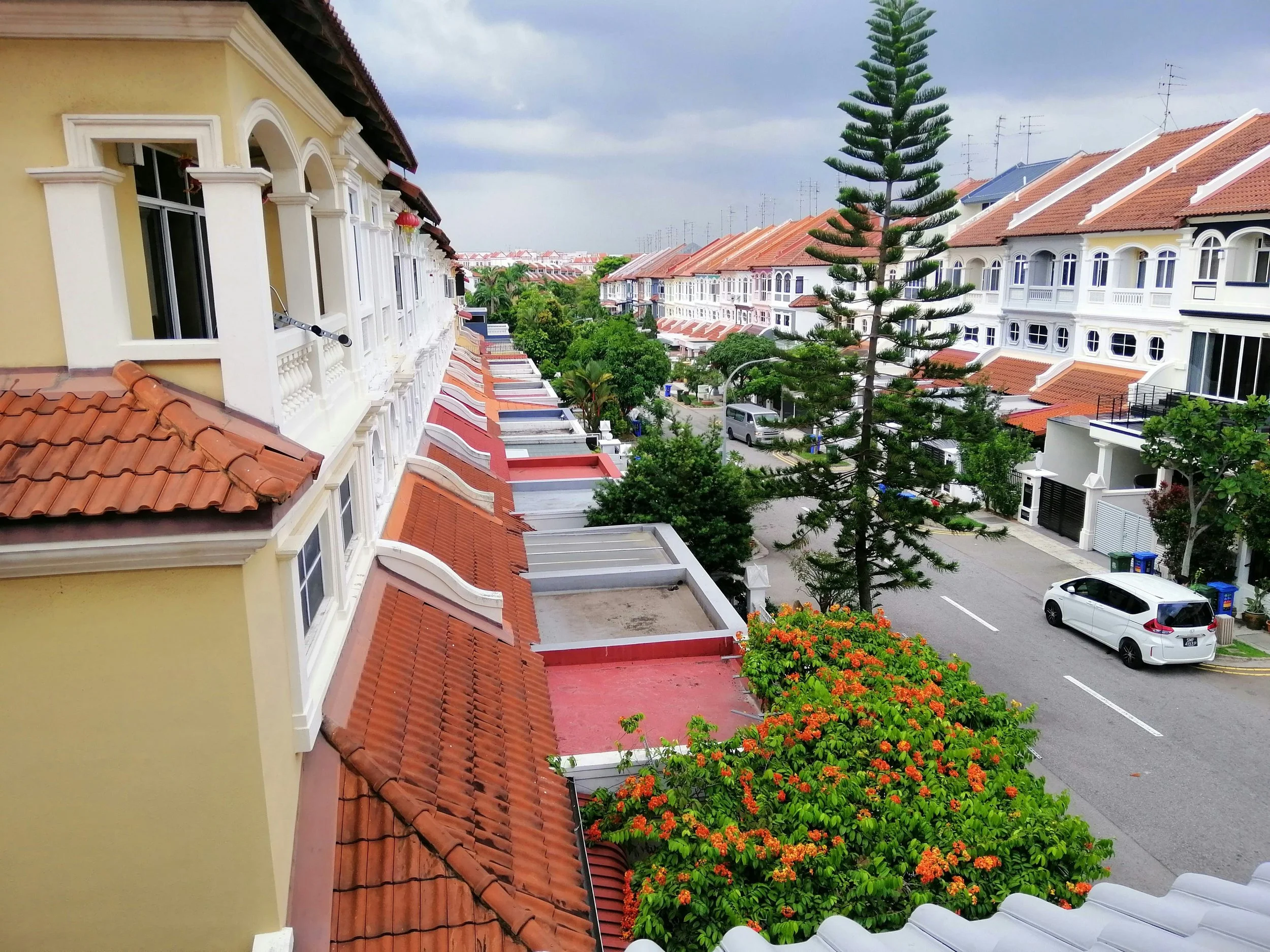
The Mechanism: The Housing Development Board (HDB)
The Core Metric:88% homeownership rate (80% of resident households live in HDB flats).
Singapore's public housing system focuses on home ownership rather than strictly rental housing. An excellent example of how the United States can use its Department of Housing and Urban Development (HUD) to increase personal home ownership across our country. Today HUD uses limited programs with similar effect, but it can be improved.
The Singapore system operates like a finely tuned clock:
The Pension Pipeline: Citizens can use their Central Provident Fund (CPF) to fund their down payments and monthly mortgage payments.
Anti-Speculation Guardrails: To stop people from treating public housing like a day-trading account, Singapore’s HDB enforces strict Minimum Occupation Periods (usually 5 years) and resale restrictions.
Radical Affordability: The median price-to-income ratio for new HDB flats is as low as 1.9. Compare that to 5.7 in New York or 8.5 in London, and the math speaks for itself.
Vienna, Austria: Social Housing Without the Stigma
Vienna’s social housing ecosystem was born during the post-WWI "Red Vienna" era under Mayor Jakob Reumann, whose administration boldly declared high-quality living spaces a fundamental human right. To fund a massive public construction blitz without accumulating debt, Reumann's government levied creative luxury taxes on high-end assets, permanently shifting the city's material reality away from private exploitation.
The aesthetic and functional genius of the model was executed by master planners like Karl Ehn, who designed monumental residential complexes featuring expansive internal green courtyards, laundromats, and medical clinics to ensure public housing remained a point of civic pride.
The Mechanism:Gemeindebau (Municipal Housing) & Limited-Profit Housing Associations
The Core Metric:60%+ of residents live in subsidized or municipal housing.
In most American cities, public housing is a heavily stigmatized, underfunded last resort. In Vienna, it is a point of national pride. Nearly two-thirds of the city's population lives in social housing, meaning doctors, teachers, and service workers live side-by-side.
Vienna’s model of social housing is an excellent model for cities with significant multi-family residential units. Think NYC, Boston, Chicago, though it does not need to be exclusively a large city housing strategy.
The Revolving Fund: Vienna's system is financially self-sustaining. Instead of relying on constant government grants, it uses revolving loans. Limited-profit housing associations are legally required to plow any financial surpluses back into building new units.
Architectural Excellence: Because the middle class uses the system, the city ensures high architectural and environmental standards. There are no "projects" in Vienna—just beautiful, integrated neighborhoods.
Rent Caps: Rents are kept at roughly 58% of private market rates, ensuring the average Viennese household spends no more than 25% of their income on housing.
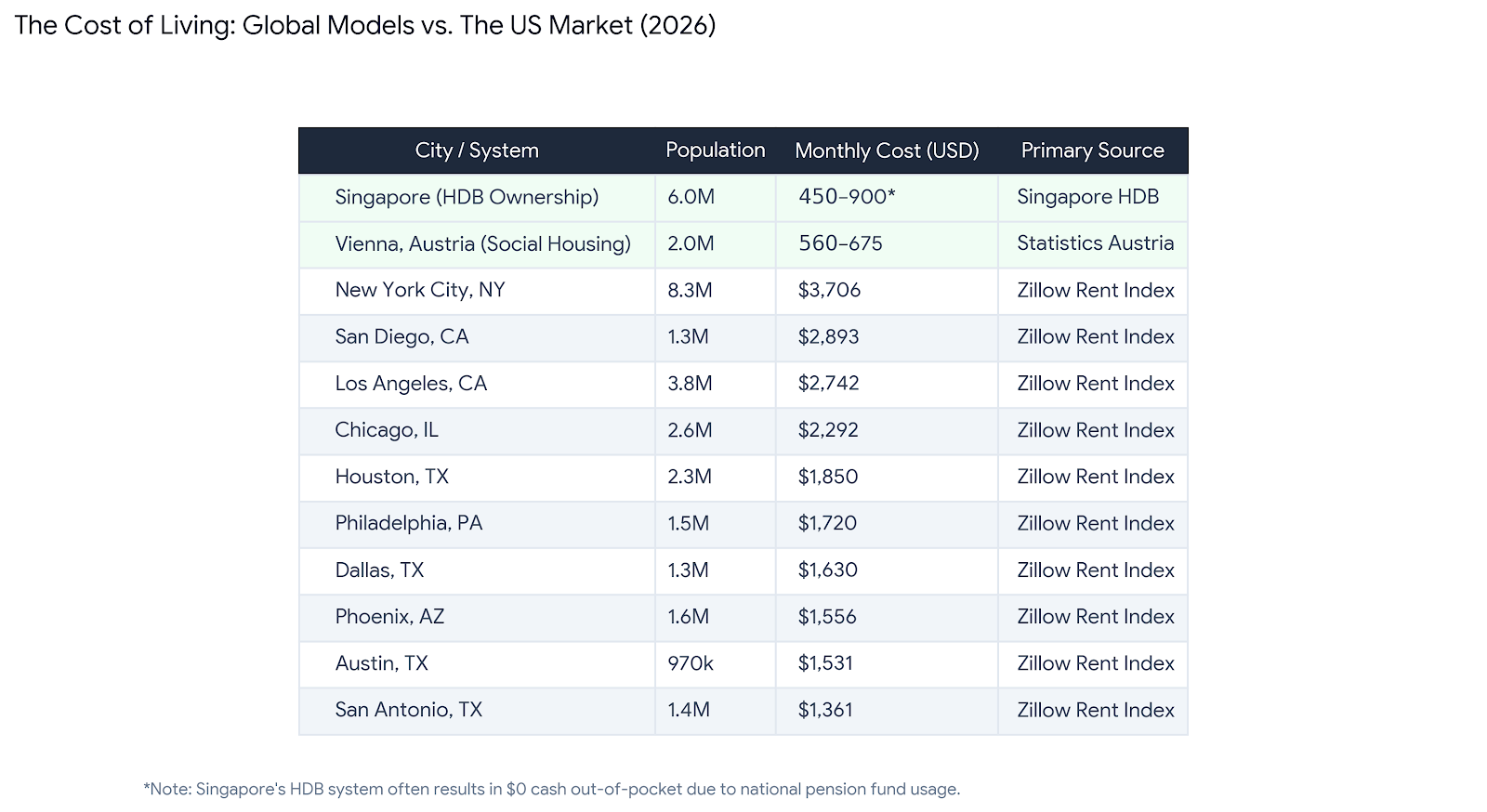
The Monthly Cost: Singapore vs. Vienna
When looking at these numbers, remember that Vienna is a rental model (inclusive of building maintenance and operational costs), while Singapore is an equity-ownership model (residents are paying down a mortgage).
Vienna, Austria (Social Housing)
Average Monthly Cost:~€516 to €623 ($560 – $675 USD)
The Reality: According to the latest 2026 data from Statistics Austria, the overall average paid rent for a municipal apartment is €516/month, while cooperative limited-profit housing averages €623/month.
Monthly Cost: Because these units are legally insulated from private market speculation, a middle-class family in a beautiful 2-bedroom municipal flat pays roughly $650 a month.
Singapore (HDB Public Ownership)
Average Monthly Cost:~$450 to $900 USD (approx. S$600 – S$1,200 SGD)
The Reality: Because Singaporeans buy their flats directly from the government at a subsidized rate, they carry a mortgage. The government's standard concessionary housing loan interest rate is fixed at 2.6%.
Monthly Cost: A typical 3-to-4 room HDB flat results in a monthly mortgage payment of roughly S$700 to S$1,100. However, because citizens are legally allowed to pay 100% of this mortgage using their mandatory national pension funds (CPF), the actual out-of-pocket cash cost for most Singaporean families is $0 per month.
When comparing to the US market, we can see the difference.