How San Antonio can invest in its people
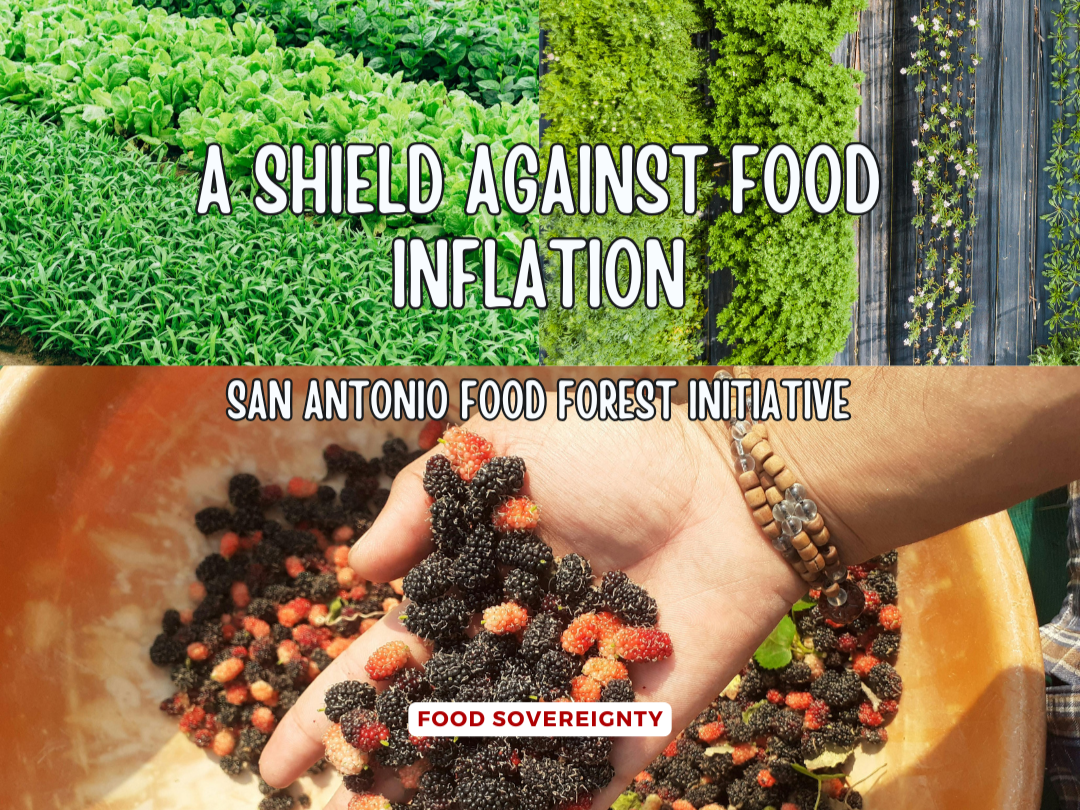
Imagine if we created public policy around food inflation by directly investing in locally produced food forests and ranchlands that cultivate and harvest a wide variety of fruits, vegetables, herbs, flowers, and meats for the local market exclusively. All owned and operated by the city and/or county.
Food produced through this initiative would be organic, fresh, free, or at a sharply discounted rate for all San Antonio residents.
Investing in publicly owned regenerative farms, ranches, and community gardens helps us lessen our dependency on the global food supply chain, a problem we first encountered after the Pandemic and will see occur soon as the Persian Gulf remains closed.
It is still early in the Iran conflict, but I foresee incredibly dramatic shocks happening to our food supply chain soon. Prices will skyrocket, if not worse.
Ultimately, this is about giving people a grand vision for what is possible when we force the government to work for us, the people. Our food supply chain is becoming ever more global, and our dependence on a stable world economy hangs in the balance. This public investment would diversify our food supply and empower local growers at the same time.
San Antonio would be able to access clean, fresh food grown right here at home, and turn that capacity to grow and harvest into a revenue source for the program itself, one powerful enough to partially or fully fund secondary city programs like free childcare for families across the city.
For the majority of San Antonio residents, it is an effective tax cut. Grocery prices have already risen significantly by 2026, and without action, the city's +1.5 million residents face projected annual food inflation of 4% to 6% for the next decade. That inflation is not a natural disaster. It is a slow, compounding tax on every household that buys groceries, one imposed by a global supply chain that San Antonio has no control over.
So, how do we create a shield against food inflation and directly help everyday San Antonio residents? Simple. We create a 5% tax on all new housing development and land acquisition from real estate developers on the outer edges of the city for 10 years. This would likely slow down suburban growth on critical habitats in our hill country while also funding our sustainable food programs.
This 10-year tax would create an annual revenue source of $151 Million. Critical funds needed to make the proper investment for our food. The acquisition of land, the purchase of equipment, the creation of in-house organic composting and fertilizer factories using kitchen scraps from local restaurants.
This tax would be limited in scope but provide an excellent resource for the city. For the vast majority of San Antonio residents, there is no direct cost of this investment. The benefit is lower grocery bills, fresher food, and a city that is no longer at the mercy of forces it cannot influence.
And as the program matures, it would become a revenue generating program, meaning it would be able to function without taxes and produce revenue to support other functions of the city. We believe once the Shield against Food Inflation is producing surplus revenue, it should go to free childcare, education, or other policy ideas that directly improve residents' lives.
The multi-pronged initiative
The Food Forest Initiative is not a single program. It is a network of interconnected public assets, each playing a distinct role in producing food, restoring land, and sustaining the system materially and financially. Below is an overview of the table, followed by a detailed explanation of how each component will be built and operated.
The Community Gardens
This plan would invest in transforming unused public lands into community gardens, creating additional green space for neighborhoods and garden space for the community. These are professionally maintained public gardens located throughout San Antonio's residential areas, managed by Master Gardeners employed by the city. They are open to every resident, free of charge, with no membership or application required.
Each community garden site serves three functions simultaneously. First, it is a productive growing space that contributes fresh fruits, vegetables, and herbs to the free food network. Second, it is an educational environment where the general public can attend free workshops, guided tours, and hands-on classes covering topics like composting, seed saving, soil health, and seasonal planting. Third, and perhaps most importantly, it provides free individual growing plots that any San Antonio resident can reserve and use to grow their own food.
This last function addresses a gap that is often overlooked. Many residents, particularly renters and those living in apartments or dense urban neighborhoods, want to grow food but have no land to do it on. Community garden plots solve that problem entirely. A family living in a second-floor apartment can have a plot, grow tomatoes, peppers, herbs, and greens throughout the season, and bring that food home. The city provides the land, the soil, the water infrastructure, and the expert guidance to help give residents a real chance to grow abundantly.
The Public Farms
The public farmlands are the large-scale production engine of the initiative. These are expansive sites located primarily in rural and semi-rural areas near the city, selected for their soil quality, water access, and proximity to San Antonio's distribution network. Unlike community gardens, which serve neighborhoods, public farmlands are designed for volume, variety, and long-term land stewardship.
Every public farm will be designed and managed as a food forest. Rather than a hyper-focused mono-cultural system. Food forests layer dozens of plant species across multiple vertical levels, from canopy fruit trees down to ground-level herbs and root vegetables. This approach produces a wide and diverse harvest across multiple seasons, meaning the city is never dependent on a single crop succeeding or failing.
All public farmlands will operate exclusively under regenerative agricultural practices. This means no synthetic pesticides, no chemical fertilizers, no tilling that destroys soil structure, and no practices that degrade the land over time. Regenerative farming actively improves the land with every growing season, building richer soil, better water retention, and stronger biodiversity year after year. The goal is not just to produce food for the next harvest but to leave the land more productive than it was found.
The Public Ranchlands
The public ranchlands bring animal husbandry into the initiative through a model built entirely around animal welfare, land health, and food quality. The city will manage rural ranch properties dedicated to two primary animals: Bison and chickens. Both will be raised under genuine free-range conditions with no factory farming practices, no growth hormones, and no confinement.
Bison are central to this program for reasons that go beyond protein. As detailed in Section 5, bison are a keystone species for the Texas landscape. Their natural grazing behavior actively restores native grasslands, breaks up compacted soil, and sequesters carbon at scale. Managing bison on public ranch land is simultaneously a food production strategy and an ecological restoration project.
Chickens serve a complementary role on the same ranch properties. True free-range chickens foraging on open pasture produce eggs and meat of substantially higher nutritional quality than factory-farmed alternatives. They also contribute directly to the closed-loop fertilizer system by producing nitrogen-rich manure that feeds back into the composting pipeline.
The guiding philosophy across all public ranch operations is simple: the quality of what we grow is a direct reflection of the quality of life we give to the animals. Healthy land, healthy animals, healthy food.
The Closed-Loop Fertilizer System
San Antonio already collects organic waste from residential properties, so we know we have the ability to develop a city-wide composting system that feeds the food program. Most cities treat organic waste as a cost: it has to be collected, hauled, and disposed of at the landfill. This program flips that entirely. Scraps of organic waste in the system can become a resource.
Restaurants, institutions, schools, and commercial kitchens across San Antonio currently pay to have their food scraps hauled to landfills. Under this program, the city creates a network of composting facilities, positioned near the public farmlands and community gardens, that accept organic waste directly. Businesses pay the city a tipping fee, typically between $20 and $40 per ton, which is less than they currently pay for landfill disposal. They save money. The city collects revenue. And the organic waste never reaches a landfill.
That organic waste is then processed into high-quality compost and returned directly to the food forests, community gardens, and farmlands as fertilizer. The ranch lands contribute as well: chicken manure and bison byproducts are composted on-site and cycled back into the soil. The city stops purchasing chemical fertilizers for its parks and public lands entirely, saving an estimated $2 to $5 million per year in municipal maintenance costs.
Any compost produced beyond what the program itself needs does not go to waste and can be sold at discounted rates to farmers or residents, producing an additional revenue source for the city.
The Food Distribution & Marketplaces
Growing food is only half the mission. Getting it into the hands of every San Antonian, regardless of income, neighborhood, or circumstance, is the other half. The Food Forest Initiative operates two parallel distribution networks designed to reach the entire city.
The Free Food Distribution
The first distribution channel is built entirely around access, not commerce. Through a formal partnership with the San Antonio Food Bank, community centers, libraries, rec centers, and the broader food bank network, the city will establish a web of free food pickup points across all San Antonio zip codes.
Produce harvested from public food forests will be transported directly to these locations on a regular schedule. It is important to establish this program as universal. Any San Antonio resident can show up and take what they need. This isn’t about income; it is about your right to ownership of the program simply because you live in San Antonio. This isn’t a place of judgment; it is a place of pride in what we can provide as a city.
The Market Place Distribution
The second distribution channel brings heavily discounted fresh produce into the private retail ecosystem. The city will partner with grocery stores, corner stores, gas stations, bodegas, and other known marketplaces across San Antonio to stock and sell Food Forest Initiative produce at discounted rates.
The model is straightforward: the city sells its surplus produce to participating private retailers at a below-market wholesale rate. In exchange, retailers are contractually required to pass those savings directly to the consumer. The city sets the floor on the discount, and retailers cannot simply pocket the margin. Compliance is a condition of the partnership.
This approach is intentional. It meets people where they already shop. Not everyone will visit a food bank pickup or a community center. But nearly everyone buys groceries. By embedding discounted public produce into familiar, everyday retail environments, including the corner store two blocks from home or the gas station on the way to work, the initiative reaches people who would never seek out a formal food assistance program.
The Tax Plan: Who Pays, Who Doesn't, and Why
The funding behind the San Antonio Food Forest Initiative does not come from a new tax on existing residents, homeowners, or small businesses. It comes entirely from a 5% impact fee applied to new real estate development, charged to developers at the point of land acquisition and new home construction.
Developers and buyers of newly built homes on the city's outer edges will be the only ones to pay the tax.
All residents who buy existing homes, rentals, or any other type of transaction will not pay anything. Existing homeowners and renters pay nothing. And, critically, every San Antonian, including new home buyers, directly benefits from the food, jobs, and infrastructure this plan creates.
Why fund this program via taxes? Because in the end of the day, taxes aren’t bad if they go directly to benefiting our own people. And if we can use those taxes to invest in decreasing our dependence on the global supply chain, better.
I personally believe we need to increase the upfront cost of building new housing in the Hill Country. I personally believe it has led to sustained droughts and worsening water levels within our Edwards Aquifer. Our city needs to slow down the pace of growth and develop long-term plans to allow our city to grow sustainably.
Methodology & Revenue Estimation
The $151.9 million annual funding figure is grounded in publicly available 2026 San Antonio market data. A 5% impact fee is applied across two taxable categories: new residential home sales and raw land acquisitions by developers. Every variable in the calculation is sourced from established real estate and land market reporting bodies, not estimates pulled from thin air.
Stream 1: New Housing Sales Fee ($148.2M)
Units sold annually - (8,200 new homes). San Antonio averages 630 to 650 total sales per week in early 2026. New construction historically accounts for 25% to 30% of total market activity in high-growth Texas metros. 8,200 units is a conservative midpoint for the city and its ETJ.
Average sale price - ($361,531). The actual average sales price reported for the San Antonio area in Q1 2026. The median is lower at approximately $305,000, but the average is pulled higher by new construction premiums over older existing stock.
Fee rate 5% applied at closing on new construction only. Existing home sales are not subject to this fee.
Subtotal $148,227,710 (8,200 x $361,531 x 0.05)
Source: San Antonio Board of Realtors (SABOR) monthly transaction reports and the Real Estate Center at Texas A&M University, which tracks permit issuance and sales volume specifically for the Bexar County region.
Stream 2: Land Acquisition Fee ($3.75M)
Acres acquired annually - (3,000 acres). To build 8,200 homes at standard sub-rural density (approximately 2.5 to 3 homes per acre, including roads and green space), developers must consume roughly 2,700 to 3,200 acres of raw land per year. 3,000 acres is the conservative midpoint.
Price per acre - ($25,000). Sourced from Texas Land Market Reports for transition land moving from agricultural to residential use. Deep rural ranch land trades at $5,000 to $8,000 per acre. Land within San Antonio's growth path with utility access (water and electric) commands the $25,000 premium used here.
Fee rate 5% applied at the point of land purchase by the developer, before any construction begins.
Subtotal $3,750,000 (3,000 x $25,000 x 0.05)
Source: Texas A&M Real Estate Center land market reports and historical land-use conversion data for the San Antonio-Austin growth corridor.
Building a Rainy Day Fund First
As the Food Forest Initiative matures and begins generating surplus revenue beyond its operational costs, the first priority is establishing a dedicated Rainy Day Fund for the program itself. This reserve would protect the initiative against disruptions such as an unexpected drought, a blight event, a downturn in the carbon credit market, or any other emergency that could otherwise threaten operations.
The Rainy Day Fund would also serve as a strategic growth reserve, giving the city the flexibility to act quickly on opportunities such as acquiring adjacent land, expanding a high-performing food forest, or launching a new revenue stream without waiting on a budget cycle.
Once the Rainy Day Fund reaches a healthy, predetermined threshold set by the City, surplus revenue beyond that cap would no longer need to stay parked. It would be freed up for broader public investment.
The Shield Against Food Inflation
This program is, in the most practical sense, a tax cut for the majority of San Antonio residents. Not a tax cut on paper, but a real reduction in the cost of living. At the same time, choosing not to act is itself a financial decision with a cost. Food inflation is not a weather event. It is a slow, compounding tax on every household that buys groceries, and it will keep rising whether the city acts or not.
To see the true value of this initiative, the $1.5 billion in developer fees collected over ten years should not be viewed as a cost. It should be viewed as an insurance policy against the hyper-inflation of the global food supply chain. One paid entirely by developers and new construction buyers. Not by the 1.5 million residents who will benefit from it.
What Comes Next: Free Childcare for San Antonio Families
Once operational reserves are secured, the anticipated surplus generated by the Food Forest Initiative's revenue streams creates a real and meaningful opportunity to do something transformative for San Antonio families: fund free childcare. So young families can grow and provide a safe and educational environment for their children.
Childcare is one of the single greatest financial burdens on working families in this city. It is also one of the most powerful economic levers available. When parents, and especially mothers, can access affordable childcare, workforce participation rises, household income grows, and children enter school better prepared.
The details and full cost structure of such a program would require its own dedicated planning process. But the principle is simple: a self-sustaining food system, funded by developer growth, that eventually generates enough surplus can provide revenue to other programs like free childcare to San Antonio families.
The Cost of Doing Nothing
In 2026, grocery prices have already followed a significant and sustained upward trend, and the result of political and economic instability can generate higher price inflation. Over the next decade, fuel costs, water scarcity, climate volatility, and global logistics will continue to drive the price of imported produce higher. San Antonio households that remain entirely dependent on the global supply chain are exposed to projected annual food inflation of 4% to 6% or higher.
That 40% increase in grocery costs over a decade is the predictable outcome of a city that outsources its food supply to a volatile global system and absorbs the consequences without a plan.
The 5% developer sales tax is a one-time gate fee paid by those expanding the city's footprint outside of 1604 or outside of 410 south of Hwy 90. In exchange, the 1.5 million residents of San Antonio receive a permanent shield against food inflation. Over ten years, the cost of that investment is a fraction of the tens of billions San Antonio households would otherwise lose to rising grocery prices.
It is time to diversify how we, as a city, obtain the food we consume. It is time to go back to the basics, when cities only existed because they had a well throughout system for producing food for their population.
We have allowed ourselves to relinquish our responsibility for our own food and as a result, Americans across the country know our food quality has gotten worse, and the costs have gone up.
I know many will read about a tax and be automatically off this idea, but I also believe the majority of people would agree that we need to reverse course and return to the fundamentals.
A city that can spend over a billion dollars in tax revenue for a sports arena has no excuse to invest in its own people.
Fresh and Clean food is owned by us, the city. Would be a source of pride, a shining example of our neighborly culture as a city. San Antonio is unique in many ways. We are a giving people because we care and value the opportunity to provide for those we love.
I trust in San Antonio to see the vision.